
Tutorial videos, apps, and new tools: How have social media platforms transformed music education?
YouTube tutorials, Instagram Reels, TikTok videos, and mobile apps… Over the past fifteen years, the rise of social media has greatly expanded the ways we learn music.
Learning a song seems more accessible and a thousand times easier than before. However, the rules haven’t changed, and learning music still requires skills that are hard to master in just 3 minutes.
If used correctly, social media can be a great tool for learning and practicing music. Platforms, technologies, and practical tips: Discover how social media can revolutionize the way we learn music, and get some advice on how to adapt to these new tools.
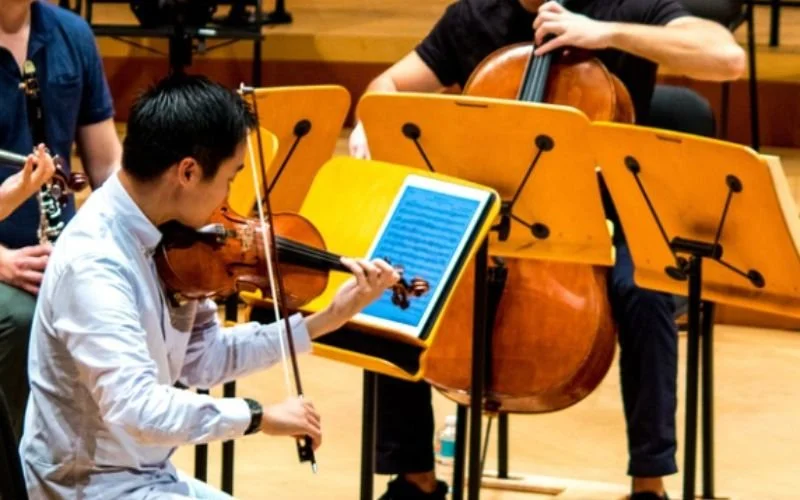
New Technologies for Music Education
The proliferation of platforms and a wealth of learning content that is readily accessible
In recent years, music has become increasingly accessible online. Videos, blogs, playlists, albums, online sheet music sites… With the multitude of platforms available for free, we now have access to thousands of educational resources without having to spend too much money.
A digital sheet music, a YouTube tutorial, an exercise, or a demonstration video on social media: you can now learn any piece of music suited to your level, at any time, with just an Internet connection. Want to improve your piano or guitar technique? There’s sure to be an online tutorial to help you.
Social media allows you to learn by observing, practice finger and hand placement, and repeat technical movements. Unlike a conservatory class that you have to attend in person, with an online player, you can slow down, pause, or review a difficult passage.
Another benefit? On social media, recommendation algorithms make it easier to discover new exercises. But be careful: the more choices there are, the harder it is to sort through them to find the right content.
🎹 10 online platforms where you can find piano sheet music.
Content that gives the impression that you can learn music in record time
The risk with social media and online video platforms is that they give the impression that you can master music in no time at all. Some accounts promise to teach you how to play the piano in one week by following an intense rythm of online exercises.
Short-form content is actually designed to hold your attention. The material presented is extremely simplified and meant to be imitated right away. But there’s a difference between playing a few notes and truly mastering a piece. When we play without thinking, our brain isn’t able to truly memorize technical or theoretical concepts.
Often, videos don’t provide explanations about the rythm, posture, or musicality. And once a student has replicated an exercise or a piece, they tend to move on to the next video without really consolidating what they’ve learned.
Short videos can therefore be effective for learning a piece by heart quickly, but they should be used in conjunction with a more comprehensive learning method.
Can you really learn music on social media?
Yes, provided that one adapts one's work methods.
Watching content on social media is fine, but it’s not enough to learn music in a way that lasts. Certain conditions must be met for the learning process to be complete. Tutorials should be viewed as supplements, not as the sole means of learning.
Before starting a tutorial, you should assess your skill level and set a goal. Avoid watching videos at random. If you’re a beginner, start by learning the basics of music theory: the fundamentals of music notation, the structure of a score or tablature, scales, the rythm, etc.
Focus on the notes, learn the different tempos, and once you’ve mastered the basics of music theory, move on to exploring the instrument. The best approach isto alternate between theory, listening, practice, and rehearsal.
For Isabelle Viennot, a music education professor at the Reims Regional Conservatory, self-directed learning isn’t as straightforward as it seems:
“I’m old-school. When I see online piano lessons, tutorials… I’m not saying it’s impossible, but it seems very difficult to me. To read sheet music (…) it requires a specific, step-by-step approach—something you can’t just snap your fingers and do on your own at home! A child can’t just read music like that. They need instruction and structured methods. It’s still possible—the proof is that there are plenty of people who teach themselves to play. But then, what about the musical quality?”
Distance music education is possible… and even very effective!
Online music lessons are becoming increasingly common. From sharing digitized sheet music and annotations to real-time audio files, these technologies help teachers better monitor their students and provide them with targeted feedback. For example, an app or web platform designed for music instruction allows teachers to record a personalized lesson that can supplement in-person feedback.
🎶 Discover Newzik Education, an online tool designed for music schools and teachers to annotate sheet music in real time, create enriched exercises, share them with the class, and track students' progress.
Social media, digital tools, and AI: new technologies that have revolutionized the way we experience music
New Ways to Learn Music
A true revolution in music education, digital technology offers advantages, but also has its drawbacks.
There are many advantages:
Tailoring exercises to a student's level or the challenges they face.
A wide variety of resources are available online.
Real-time guidance to adjust the " rythm " or pitch.
A helpful tool for visualizing notes and staves with interactive sheet music.
Quick access to backing tracks, metronomes, tuners, and separate tracks.
Progress is made more fun with interactive apps, the ability to track your performance, and the option to practice on your own.
There are also a few drawbacks to consider:
The challenge of navigating the vast array of resources, which can sometimes be difficult to organize into a coherent learning path.
It’s a quick way to learn, but it doesn’t always lead to the development of real musical skills.
A reliance on screens, apps, and tools: the learner can quickly get used to having constant guidance, without being able to play on their own.
Fewer direct interactions with teachers, even though these are essential for tailoring advice, encouraging students, and correcting their technique.
The standardization of interpretations, which can limit our ability to improvise and our creativity.
🎵 Our 5 practical and fun tips for learning music theory.
A magical guide to composing and performing sheet music
Beyond learning, new technologies have also revolutionized the way we play and compose music. Digital software and apps offer real help to aspiring musicians in reading, creating, and sharing music:
viewing corrections or automatic transformations in digital sheet music,
improving the harmonization or mixing of recorded tracks,
speeding up the creative process, particularly when creating mockups.
In computer-CAM , software even allows us to produce sound loops generated entirely by theAI. Drum tracks and human vocals can be automatically modified using generative artificial intelligence. However, this raises questions about the originality of these works and the enforcement of copyright in music creation.
There is a diverse group of self-taught artists who have emerged through social media. One such artist is Jacob Collier, a self-taught multi-instrumentalist and maverick. Discovered on YouTube in 2012 through split-screen videos, Jacob Collier covered songs by playing all the instruments himself and harmonizing with his own voice entirely on his own.
Are you learning music or composing on your own at home? Use an app to help you! Newzik lets you:
Tracking your performance.
Automatically transpose your sheet music with LiveScores.
Sharing your annotated sheet music with teachers or other musicians remotely.
Organize your digital sheet music and audio files in one place to make it easier to find your work documents.
5 Tips for Learning Music Using Social Media
1. Learn some theoretical basics before you begin
Videos aren't everything when it comes to learning music. It's a good idea to understand the rythm and to read the notes or sheet music before starting a tutorial shared on social media or a platform.
When playing the piano, for example, don't just mechanically memorize finger positions. Learn the basics of bars, tempo, and the vocabulary to help you find material that's right for you.
2. Choose videos or tutorials that are appropriate for your skill level
Search for resources by level, technique, or piece. Don't rush things by trying an exercise that's too difficult—you might get discouraged.
Take the time to go through each piece of content, and choose well-structured videos or resources (avoid selecting a tutorial that promises unrealistic results). It’s better to start with a simple exercise than with content that seems out of reach.
Look for videos that also include a sheet music, tablature, or written guide so you have a reference document to consult.
3. Take your time
Don't rush it—music is an art that takes time to learn and master. Not everyone can be Mozart!
At the start of each practice session, set a specific goal for yourself, such as learning the structure, notes, or " lyrics " of a song.
Start by breaking down the piece you want to learn into short sections. Then work on each section slowly before increasing the tempo.
Practice regularly rather than trying to learn everything in one session. Work in short sessions on a regular basis (30 minutes a day, for example).
4. Use a tool to track your performance
When it comes to analyzing and improving, there’s nothing more effective than listening.
Choose software or an app that lets you record your various performances so you can listen to them, check the consistency of the tempo, and verify your pitch. This will help you identify the passages where you’re struggling and work on them in more detail.
Feel free to take notes and keep track of your progress. Are you taking a music class? Share this recording with your teacher—they’ll be able to give you feedback.
Our tip: Work with an digital sheet music to make it easier to read and mark passages that need work during your rehearsals. The Newzik sheet music reader app, for example, lets you convert a performance into an interactive score, and also start a metronome to help you keep your playing in time with the rhythm.
5. Take classes at the same time to get an outside perspective
While social media promotes self-directed learning, getting feedback from a teacher as a supplement will help you make faster progress.
A teacher seriously corrects bad habits, tailors their advice to your level, and sets achievable goals for you. Having a teacher guide you also provides a consistent perspective and more detailed feedback than what you might find in an impersonal YouTube video.
💡 Learning Music: Where to Start?
❌ Music Education and Social Media: Pitfalls to Avoid
A few common mistakes can throw a wrench in your plans when you're learning music through social media or digital platforms.
To get the most out of online resources, avoid:
Choosing pieces that are too difficult for your level: you risk getting discouraged and giving up when faced with the workload.
Don't neglect your posture, warm-up, or breathing: take the timeto get comfortable with the instrument and learn how to hold it properly. When singing, be sure to warm up your voice properly.
Comparing yourself to edited or heavily polished work: every learning experience and every skill level is different. Comparing yourself to others is a waste of time, especially when you’re just starting out and have everything to learn.
Spending more time watching videos than practicing, rehearsing, or correcting your mistakes: On social media, the allure of videos can distract you, and you end up scrolling mindlessly—and, most importantly, without actually doing the exercise! Set aside a specific block of time dedicated to focused practice, separate from watching videos.
🎼 How about switching to an app that makes it easy to learn music… without neglecting the basics?
With Newzik, you can record your performances, annotate, share, and organize your sheet music, all while using collaborative tools to support your rehearsals. It’s a real help in simplifying every step of the music-learning process!
Try NewzikApp now and enjoy your first few days for free ⭐
FAQ – Frequently Asked Questions About Music Education on Social Media
Is it possible to learn music on your own?
In theory, it is possible to learn the basics on your own using tutorials, apps, and digital sheet music. However, guidance from a teacher is still helpful for correcting your posture, avoiding bad habits, and developing a consistent progression.
What's the best app for learning music?
There are many apps available for learning music. Which one you choose depends on your instrument and your goals. Select an app that’s suited to your skill level, with step-by-step exercises, clear instructions, and tools to track your progress.
Newzik makes it easier to read sheet music, annotate certain passages, record yourself, and receive real-time feedback from remote teachers.
What is the easiest instrument to learn on your own?
The ukulele, the keyboard, and certain percussion instruments are good choices for beginners. But in reality, consistency, motivation, and the quality of the teaching method matter more than the choice of instrument.
Can you learn music using a mobile app?
An app can help you learn the basics, work on your rythm, read sheet music, and track your progress. But using an app isn’t enough on its own; it’s recommended that you supplement it with regular practice and seek expert guidance from a teacher.
