
Music lessons: how to manage different levels?
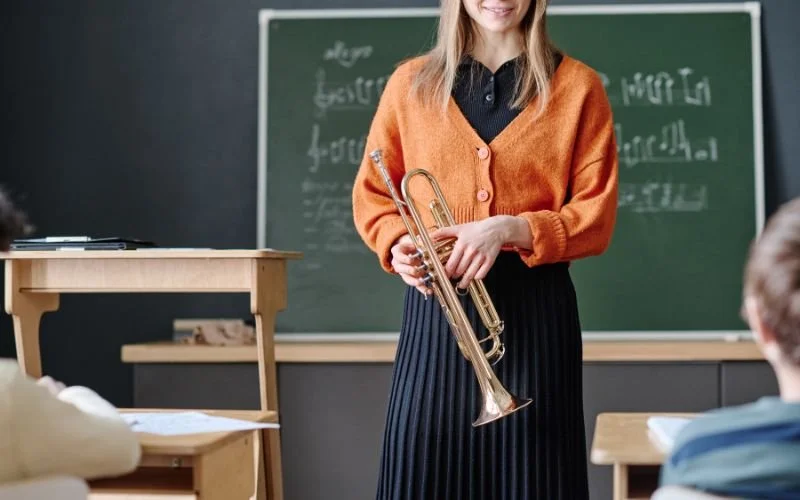
Beginners, advanced students, highly independent learners, and others who need reassurance: managing different levels in the same music class has become a common situation for many teachers. In group classes, music schools, or conservatories, heterogeneity is now part of everyday life.
How can you organize your class without losing anyone along the way? What techniques can help every student progress, regardless of their level? With the right teaching methods and appropriate objectives, a class with students of varying levels can become a real driving force for collective learning.
😊 Key points to remember
Collective learning allows students to progress through listening, observation, and imitation.
The same exercise can work for everyone, provided that expectations and objectives are adapted.
Open exercises (rythm, listening, roles, interpretation) are best suited to heterogeneous groups.
Shared materials (partitions, annotations) facilitate continuity between two lessons.
Managing different levels: a common challenge in music education
Even when classes are organized by level, differences quickly become apparent. Within the same group, some students are comfortable with reading, while others rely more on ear training. Some progress quickly, while others need more time to understand, repeat, or feel confident.
These differences are normal. They stem from each person's background, how much time they spend practicing at home, their age, or simply their learning style. Over time, the group evolves, but rarely in a uniform manner.
For the teacher, this is the real challenge: helping everyone progress together, without frustrating those who are faster or discouraging those who need more guidance. This is a very common situation in group classes, and one that requires flexibility and attentiveness above all else.
The basics of group teaching in music
In group classes, success depends not only on the individual level of the students, but also on how well the group works together.
Group learning: an asset in music class
Collective learning is sometimes associated with a loss of efficiency, due to fears of having to slow down for certain students. In reality, the group can become a powerful educational driver when it is well supervised.
Watching a classmate play, listening to different ways of approaching the same passage, learning by imitation or contrast: these situations enrich musical understanding. Students develop their ear, their sense of listening, and their analytical skills.
This group dynamic benefits everyone at every level. The more advanced students consolidate their knowledge by demonstrating or explaining, while beginners make gradual progress.
The role of the teacher in collective learning
In a class with varying levels, the teacher's role evolves throughout the course. It is not a question of interacting constantly with each student, but of maintaining an overview of the group. Like a conductor, the teacher organizes work time, distributes attention, and adjusts the rythm of each lesson.
This means accepting that some students can work independently while others need more targeted support.
Please note for music lessons with children
In children, heterogeneity does not always reflect a difference in ability, but rather differences in concentration, maturity, or rythm . Focusing on listening, imitation, and group play helps maintain a positive dynamic for the whole group.
Adapting your music lesson without making it more complex
When levels are mixed, there is a strong temptation to increase the number of exercises, materials, or instructions. As a result, lessons become more difficult to prepare and harder for students to follow. The goal isto learn how to work on several reading levels using the same content.
Behind this organization lies a pedagogical consideration: how can the same musical content be conveyed to students with different profiles and levels?
One goal, multiple levels of interpretation
The same exercise can be perfectly suitable for the whole group, provided that expectations are adjusted. The principle is simple: everyone works on the same basis, but not with the same level of difficulty.
A beginner can focus on rythm or accuracy, while a more advanced student will work on articulation, nuances, or interpretation. The piece is the same, as is the overall goal, but the criteria for success evolve according to the level.
This approach also avoids the "double program" effect, which is often exhausting for both teachers and students.
Differentiating levels without stigmatizing
Adapting exercises should never lead to pigeonholing students into categories. The aim is to reward individual progress, not to compare levels between students.
Rather than dividing students into "good" and "less good" groups, focus on progressive goals. A student may be comfortable with rhythm but struggle with reading, or vice versa.
By focusing on the progress made rather than the level achieved, you create a climate of trust that is conducive to collective learning. Students are more willing to try, make mistakes, and progress without feeling judged or excluded.
Facilitate follow-up and group work with Newzik
Managing different levels often requires juggling between media, annotations, and personalized instructions.
With Newzik, teachers can centralize sheet music, annotations, and teaching notes in one place. Students work on the same documents, while adapting their reading or annotations to their level. Everyone progresses at their own rythm, without losing track of the group.
The app also allows teachers to prepare lessons in advance, track progress between classes more easily, and encourage independence in both students and children. It is an essential tool for teaching groups of students of all levels.
Discover the Newzik app for free! (7-day trial period)
3 techniques for managing different levels in music class
Role-based work
Assigning specific roles within the group allows everyone to work simultaneously, without imposing the same level of difficulty on each student. Each musician contributes to the ensemble according to their current abilities.
You can divide students into groups based on complementary musical roles:
rythm : pulse, rhythmic ostinato, body percussion, or accompaniment
Harmony: chords, inversions, left-hand accompaniment
Melody: main theme, variations, phrased
Accompaniment: arpeggios, counter-melodies, sound textures
This organization promotes collective listening and gives meaning to group work, without creating a rigid hierarchy between levels.
Working in subgroups
Working in subgroups is particularly effective for managing heterogeneity, provided that it remains flexible and adaptable. The aim is not to create permanent groups, but to vary them according to the objectives of the course.
Our advice:
Form temporary groups linked to a specific exercise or a specific difficulty.
Regularly change the compositions to avoid level labels.
Give clear instructions to encourage independence while you are assisting another group.
While one subgroup works independently (reading, rehearsing, annotating), the teacher can focus on another, offering targeted advice or correcting a tricky passage. This alternation between student independence and individualized support makes the lesson more fluid and balanced.
Learning music through listening and observation
Learning to play an instrument is not just about practice. Observing, listening, and analyzing are also part of the process, especially in a group class.
Suggest times dedicated to:
Watching a friend play
Active listening to a passage worked on by the group
Annotation or constructive feedback (what works, what can be improved)
These moments develop the ear, concentration, and the ability to verbalize music. They also allow students to progress without playing constantly.
Adjusting a piece without changing the key: the secret of transposition
In group lessons, the same piece can quickly become problematic: too high-pitched for some, too low-pitched for others, or technically uncomfortable depending on the level. Transposition allows this difficulty to be resolved without changing the material.
Transposing a piecemeans keeping the same musical structure while adapting it to the voice, instrument, or level of each student. The group works together on the same content, but in conditions that are more appropriate for each individual.
With Newzik, transposition is instantaneous. Teachers can adjust a piece on the fly, without having to make multiple copies of the sheet music or interrupt the music lesson.
How to prepare a music lesson with different levels?
How should you respond if a group progresses faster than expected, or if some students need more time? Lesson preparation must take this reality into account. Rather than setting the content in stone, it is better to plan adaptable exercises and ready-to-use alternatives.
For example:
Exercises with multiple difficulty levels, adjustable during the session
Simple variations to deepen the same piece of work (rythm, nuances, articulation)
Plan Bs to keep a faster group busy while you accompany the others
This flexibility allows you to remain pedagogically available without disrupting the class or frustrating the students.
Essential accessories for a beginner musician
FAQ - Teaching music to groups of children and students
At what age can children start taking group music lessons?
There is no specific age, but as soon as children are able to listen to others, wait their turn, and follow simple instructions, group lessons become interesting. The challenge is not technique, but the ability to evolve in a shared environment.
Learning music: at what age should you start?
How can you avoid comparing children in group classes?
Focus on each student's progress rather than their results. Remember that not all children progress at rythm same rythm emphasize listening and teamwork to avoid competition.
Is group teaching suitable for all types of students?
Not always in the same way. Some students need individual time with their teacher to progress, but even in this case, group work can be a useful complement.
Which exercises work best with different levels?
Open exercises with several levels of difficulty. The same piece or exercise can be approached differently depending on the students: rythm for some, nuances or interpretation for others. Role-playing and group listening exercises work particularly well.
