
8 Mistakes to Avoid When Transposing a Score
As an instrumentalist, you often needto adapt the tonality or melody of your sheet music in order to play it differently or harmonize it with a group of other instruments. A very common practice in music, transposition requires proficiency in reading sheet music as well as in writing and understanding melodies.
And even if you’re a music theory whiz or know a score by heart, it’s not always an easy task. Certain mistakes can prevent you from achieving the right harmony, the right range, and the right tone. Omissions, poor choice of tonality, overlooking certain chords… Newzik guides you in avoiding the main pitfalls of transposition!
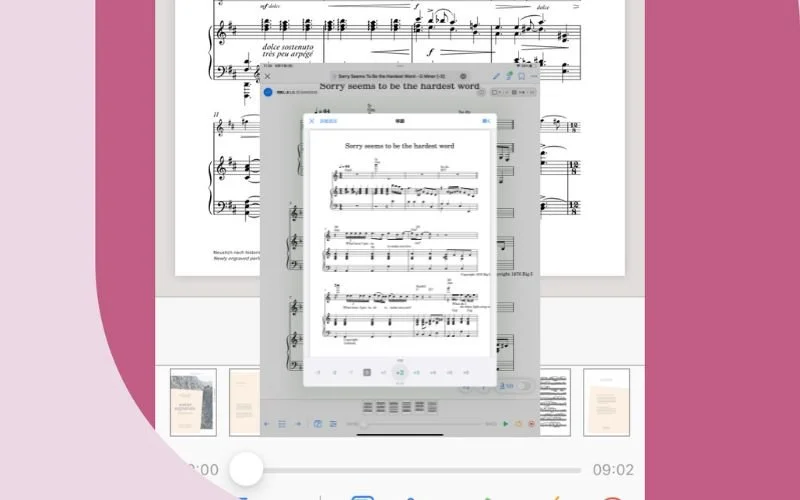
Transposing a score: What's the point?
Harmonizing a score for an entire ensemble of instruments
Transposing a score means changing the piece’s tonality —that is, raising or lowering itby one tone or several semitones.
When several musicians play together, transposition allowsthe piece to be adapted to the specific characteristics of each instrument. A melody written for the piano, for example, can be played on the flute or the saxophone, but certain keys may be more difficult to play depending on the instrument. This is where transposition comes in: by changing certain note pitches, it is possible to adapt the musical notation to a particular instrument.
Let’s take the example of transposing a recorder score:if a melody starts too low to be played comfortably on a soprano recorder, you can transpose the score up. → A phraseof C–D–E–C, transposed a fifth higher, will becomeG–A–B–G.
Transposition is also essential for transposing instruments, such as the trumpet or the B-flat clarinet. For these instruments, a written C actually produces a B-flat. The sheet music must therefore be adapted so that all musicians play in the same key tonality , and the ensemble remains harmonious.
💡 Tones, semitones, and intervals: Everything You Need to Know About Musical Scales.
Adapting a piece to a vocal range or playing level
The use of transposition is particularly useful for singers, as it is a technique that allows themto adjust the pitch of a song so that it better suits their vocal range. For example, a piece written with a tonality e that is too high for a baritone can be transposed down. This will make the performance more comfortable for the singer without altering the melody.
tonality Transposing a score can also make it easier to perform a piece by choosing a key with fewer sharps or flats. As a result, the musician retains the original melody and intervals while enjoying a technically more accessible version. This can also be very useful for teachers working with beginner musicians. Young students practice in the treble clef or bass clef before moving on to other pitches.
The advantage is that transposition is possible for all instruments, all keys, and various forms of musical notation, whether it’s a score, tablature, or chord charts.
8 Mistakes to Avoid When Transposing a Score
Even though it may seem simple or obvious to experienced musicians who have studied music theory, the art of transposition requires a certain degree of precision. Mistakes can happen, even to the best of us. Here is a list of the most common errors.
1. Confusing transposition with a change in octave
One of the most common mistakes in transposition is confusing a change in key ( tonality ) with a change in octave.
Changing octaves is equivalent to shifting all the notes eight semitones higher or lower. A C therefore becomes another C—higher or lower—but the tonality , and the notes of the melody remain the same.
Transposing a score, on the other hand, involves shifting each note by the same interval in order to play the piece in a new key tonality.
A piece in C major transposed to F major will thus begin with an F, rather than a C in a different octave. The intervals between the notes remain the same, but their pitch and the key signature of the score are changed.
2. Choosing an in tonality e that is unsuitable for the instrument or voice
When transposing a score to adapt it to a vocal range or a type of instrument, you must choose the right new tonality. Transposing too high or too low can make certain passages difficult, or even impossible, to play.
And don’t forget that a transposing instrument doesn’t sound exactly as written. This is true of the clarinet, saxophone, trumpet, the recorder family, and the horn, which don’t always play the note that is actually heard. To create the correct transposition, you must therefore take into account the instrument’s specific in tonality .
💡 Take the time to tailor your sheet music to each musician!
With Newzik, you can create different versions of the same song, adjust their tonality, and export them as a ready-to-play version that you can store in a well-organized digital library.
3. Not noticing changes in the song' tonality
Some pieces do not remain in the same key tonality from beginning to end: they may include one or morekey changes, which are indicated by a new key signature or a series of accidentals.
If these changes are ignored, there is a risk of creating passages that are harmonically inconsistent. Changing the " tonality " does not mean simply copying and pasting the same progression throughout the entire score. Each change in " tonality " must be identified and then transposed while preserving the harmonic relationships established in the original version.
💡 Handy tips for Newzik:
Make it easier to analyze your sheet music by zooming in on the staves of your scanned document and moving your cursor along as you read. You can also annotate each section of the sheet music to indicate where the change in tonality occurs.
4. Making mistakes with transposition intervals
Another common mistake: changing the notes without strictly adhering to the chosen interval.
When transposing,each note must be shifted by the same interval— whether it’s a third, a fourth, a fifth, or any other type of interval. A single mistake can alter the melody, create dissonance, or change the entire harmony of a passage.
Be sure to specify the quality of the interval as well. A major interval is not the same as a minor interval, and a perfect fourth is not necessarily the same as an augmented fourth. The best practice is to check the number of whole tones and half tones in each interval to make sure you’re transposing correctly.
5. Forgetting to adjust armor and modifications
Transposition isn't just about the notes visible on the staff. It also involves adjusting the key signature of the score—that is, sharps and flats—as well as certain chords and chord symbols.
Sharps, flats, and naturals must be adjusted to fit the overall harmony of the piece.
💡 Save time when arranging music. Import your score into NewzikApp and transpose it to the desired key tonality without having to rewrite the entire piece.
Our step-by-step guide to importing a sheet music file (scan or PDF) into Newzik.
6. Neglecting chords and accompaniment symbols
In a score that includes a harmonic grid, you must also transpose the chord names and the accompaniment symbols. Simply moving the notes one by one would result in a mismatch between the notes played and the song’s harmony.
If you transpose a melody from C major to F major, a C major " chord " must become an F major " chord ." The same interval must be applied to each " chord." For example, a D minor " chord " must remain minor after transposition. That is why it is advisable to check that the nature of the "chord " remains unchanged: major, minor, seventh, or diminished.
7. Do not proofread the transposed score
Proofreading is an essential step after any musical arrangement.
After transposing your score, play or listen to the piece to identify notes outside the range, inconsistent accidentals, and notation errors. Make sure the layout is legible, clear, and free of any misleading information.
Playing the transposed score is an excellent way to spot a wrong note or a harmony that sounds off. Pay special attention to notes at the extremes of the instrument’s or voice’s range.
Our technical tip? Use the transposition feature at digital sheet music to minimize errors caused by retyping or annotating when you transpose your document.
9 Good Reasons to Work with Digital Sheet Music.
8. Creating multiple versions without organizing them properly
Musicians often don’t transpose just a single score. In the case of an orchestra, for example, transpositions are created for different instruments, so multiple versions can pile up. One score in C, another in B-flat: without organizing these transpositions, it’s hard to keep track of them, open the right file… and share the correct version with the other musicians!
To avoid confusion, give each score a specific name that indicates the tonality, the instrument in question, or the musician's name. Also, be sure to keep the original version so you can refer back to it if necessary.
6 Mistakes to Avoid When Working with Digital Sheet Music.
How do you transpose a musical score correctly?
Transposition involves changing the pitch of notes while preserving the melodic and harmonic intervals. To transpose effectively, you must first have a solid grasp of music theory so that you understand what a note, a scale, or an interval is.
Identify the correct transposition interval
Determine the original key tonality , the key you want to reach, and the interval between them. For example, moving from C major to E-flat major is equivalent to transposing all the notes up a minor third.
Move each note by the same interval
Apply the same shift (with a similar interval) to each note. Example:
Do becomes E♭.
D becomes F.
Mi becomes Sol.
Fa becomes A♭.
G becomes B♭
A becomes D.
"Si" becomes "Ré"
Example: Let’s take the sheet music for“Frère Jacques,” which begins on C. Suppose you want to transpose the melody to G. The interval between C and G is a fifth—that is, three and a half tones—tone. You must therefore raise each note in the piece by that same interval.
Do – re – mi – do / Do – re – mi – do
Will result in:
G – A – B – G / G – A – B – G
Adapting Armor to Status Effects
The key signature of a transposed score must be changed to match the new key tonality. For example, when transposing from C major (no accidentals in the key signature) to E-flat major, three flats must be added to the key signature: B-flat, E-flat, A-flat.
Transposing Chords
The chords must also be transposed by the same interval as the melody. For example, when transposing “ tone ” to a higher pitch, here is the result:
C major becomes D major,
F major becomes G major,
B-flat major becomes A major.
The nature of each chord must be preserved: major, minor, seventh, or diminished.
Play the new version and record it for analysis
To make sure that all the notes and chords have been transposed correctly throughout the new version, listen to your transposition.
Newzik lets yourecord your audio performance and transpose your recording into sheet music. This technique is ideal for quickly identifying a mistake or an in tonality that doesn’t suit the instrument’s range.
Transpose, annotate, organize, and share your sheet music all from a single app.
Use a digital sheet music management app to transpose your sheet music without having to start from scratch! When you switch to Newzik, you’ll:
→ Share pieces and annotations in real time with a student, an ensemble, or a group.
→ Change the tempo or the " tonality " with just a few clicks.
→ Reorganize your partitions and access them at any time.
→ Transpose your sheet music in an instant.
→ Use LiveScore technology to generate a playable MIDI file from PDF sheet music.
📲 Download Newzik and try out its features for free right now. Let’s Play!
FAQ – Common Questions About Errors in Musical Transposition
What is musical transposition?
Transposing a scoremeans changing its tonality —that is, raising or lowering it by one or more semitones while preserving the intervals between the notes. This technique is used in particular when several musicians play together: it allows them to play the same melody in a different tonality , adapted to an instrument or a voice.
How do you perform a transposition?
Before attempting to transpose a piece, you need to make sure you have a solid grasp of the basics of music theory: knowing how to read and write a note, recognize a scale, or an interval.
Once you have analyzed a score and determined the desired tonality , move each note by the same interval, adjust the key signature to reflect the accidentals, transpose the chords, review the document carefully, and then play through the score before finalizing the transposition.
With the Newzik digital sheet music management app, you can convert your PDF to LiveScore and then change its tonality or key with just a few clicks.
How do you transpose the chords of a song?
To transpose the chords of a song, start with the basic tonality and count the number of semitones you need to add or subtract to reach the desired tonality . For example, if you’re transposing a song from G to C, add two and a half semitones. If you’re transposing a song from F to A, add two semitones, and so on.
What are the most common transposing instruments?
Here is a list of the most popular transposing instruments:
The clarinet(in B♭, A, and E♭).
The different types ofsaxophones: alto, tenor, baritone, and soprano.
The trumpet(B♭, C, D, E♭).
The French horn (oftenwrittena fifthhigherthan the actual pitch).
The tubaand bass instruments, whicharesometimesspelleddifferently depending on the region.
The family ofrecorders, some of whichtransposebyan octave.
