How to practice duets and four-hand pieces on the piano?
Playing the piano together opens up a whole new way of approaching music. With four hands, everything is shared: the keyboard, the space, the intentions. Two pianists side by side on the same instrument, listening more intently, each movement taking on a different presence. This closeness changes the relationship with the piano and adds a new dimension to playing.
Four-hand piano playing is not just for virtuosos: it is accessible and educational for everyone, whether you are a beginner, an experienced player, an adult, or a child.
Playing the piano as a duo also raises a few questions: what guidelines should you follow to work effectively as a duo? Which pieces should you choose to get started?
Want to improve your piano playing as a duo? This guide brings together the essentials for better understanding what makes four-hand playing so powerful, learning how to practice it on a daily basis, and developing more natural coordination over the course of your sessions.
Playing four-handed: roles, positions, and reference points
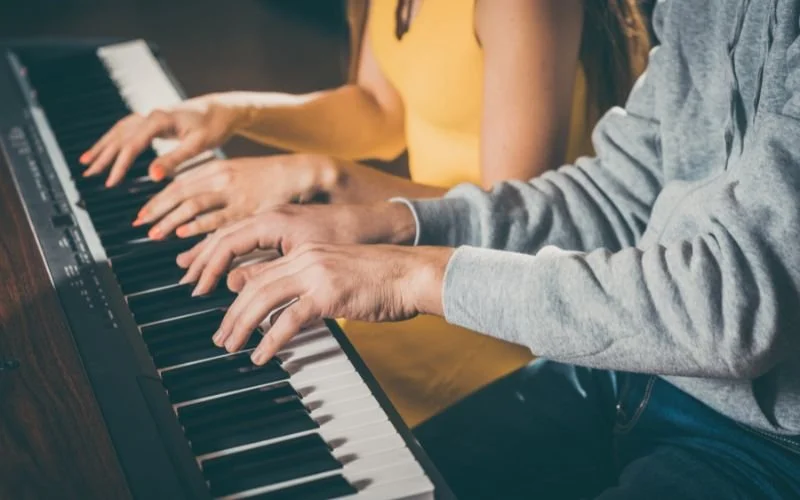
Playing piano four hands means that two pianists share the same keyboard, each with their own role and playing area. The secondo sits on the left, on the bass side, while the primo sits on the right, on the treble side of the piano. This arrangement creates a richer musical texture, sometimes even resembling an orchestral arrangement.
As early as the 18th century, Mozart, Schubert, and Czerny wrote works intended to be played on the piano by two hands. At a time when recordings did not exist, this was one of the most common ways to discover great works directly in people's living rooms.
Even today, this practice remains a wonderful learning experience: it encourages listening, rhythmic precision, and a more collective approach to music. Whether you are a beginner or an advanced player, four-hand piano allows technique to serve musical dialogue.
🎹 Are you a pianist? Discover the essential accessories for playing the piano.
A brief history of four-hand piano playing
Four-hand piano music appeared at the end of the 18th century, while the pianoforte became popular in salons. In 1777, Charles Burney published a collection of duets in London, considered one of the first printed publications dedicated to the genre. Mozart had already paved the way a few years earlier with his sonatas and variations for two.
The 19th century marked the golden age of four-hand piano playing, thanks in particular to Franz Schubert. At a time when recordings did not yet exist, four-hand piano playing brought orchestral music into people's homes. This function then declined with the advent of the record, which gradually replaced these "domestic concerts."
The repertoire has grown over time: Brahms' Hungarian Dances, Debussy's Petite Suite, Fauré's Dolly, Ravel's Ma Mère l'Oye...
How to work on your piano scores together?
Playing as a duo requires a few adjustments. Nothing complicated, but there are a few things to get used to. Where should you stand? Who leads? How can you stay together without stress? Here are a few tips.
Positioning yourself at the keyboard: finding balance
When playing piano as a duo, it is also important to know where to sit so that everyone has enough space. The secondo sits on the left, slightly behind. The primo sits on the right, closer to the keyboard. Why? To avoid getting in each other's way and to keep enough space when their hands cross. The goal is to feel free to move without crowding or bumping into each other.
Finding a common tempo
The start is often the tricky part. Who starts? How can we be sure we're all starting together? Sometimes, taking two seconds to breathe at rythm same rythm . Counting the first beat mentally also helps. And above all: start slower than planned. The speed will come naturally.
Work in small steps
Playing everything in one go doesn't achieve much. When playing in a duo, it works much better to progress in short fragments. Two or three lines. A tricky passage. A repeat that needs clarifying. We rehearse, we adjust, we start again. This format allows us to establish coordination without fatigue and to secure the key points of the piece.
Cultivating mutual listening
A duo progresses when each person hears what the other is doing. Volume, articulation, breathing: everything flows more easily when you pay attention to your partner's nuances. A quick chat before each session ("shall we play lighter? more connected?") is often enough to clarify the intention.
Manage the pedal from the start
The pedal is really a two-person job. It's best to decide quickly who will be in charge of it to avoid blurred sounds, especially in fast movements. A simple chord during the first rehearsals makes playing much cleaner.
Working separately even when there are two of you
Each person can play their part while the other listens. This method highlights fragile passages, possible discrepancies, or delicate hand crossings. It is a very effective approach for gaining precision before bringing the two voices together.
Look at the keyboard, but not too much
Playing four-handed requires trusting your instincts. Looking at the keyboard too much can distract the other player. Lifting your head slightly, listening more, feeling the movement: these small gestures improve coordination effortlessly.
Record to progress
A quick recording can reveal things you don't notice when playing. A slight discrepancy, a forgotten nuance, a passage that lacks momentum... It's not a check, just a simple tool to help you adjust together and progress faster.
Want to take your duet scores to the next level?
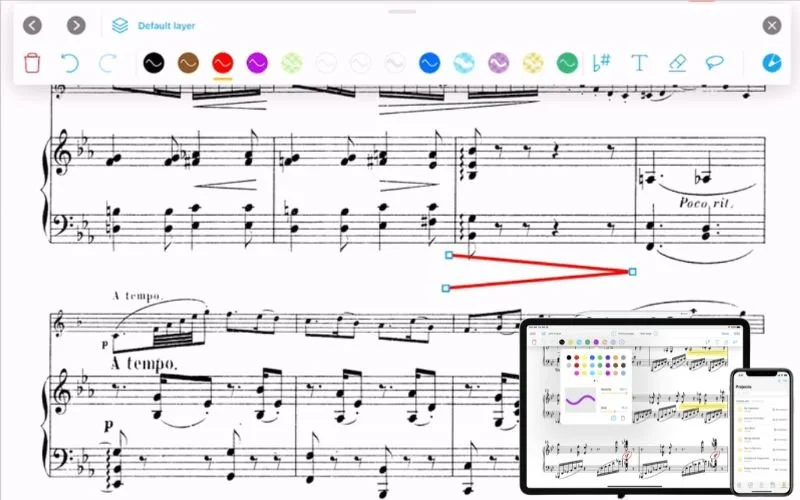
Newzik supports you in learning piano together: importing sheet music, shared annotations, work tools, built-in metronome...Everything is designed to help you progress together, wherever you are.
Try Newzik for free and discover a new way to organize your duo sessions.
Playing the piano together: what it changes and what it brings you
When you start playing piano as a duo, you quickly realize that practicing takes on a whole new dimension. You're no longer just playing for yourself: you listen, you adjust, you seek the right balance. And this shared attention helps you progress almost without realizing it.
The first positive effect is listening. You learn to hear others as much as yourself, to adapt your touch, your volume, your musical breathing. This makes your playing more flexible and precise, even when working solo.
Playing with two people also helps enormously with the rythm. You can't speed up or slow down without warning: you have to keep a common tempo, anticipate nuances, and stay together. It's excellent training for all levels.
Is four-hand piano suitable for beginner musicians?
Yes, and it's even an excellent introduction to playing in a duo. Many teachers incorporate four-hand playing into their lessons, as this format helps to stabilize the rythm understand the structure of a piece more quickly. It's an accessible, motivating approach that's perfectly suited to those taking their first steps on the piano.
Playing as a duo: the secret to daring to perform live
Preparing a piano duo concert allows you to organize your work with greater clarity: choosing the tempo, sharing intentions, dividing up the movements, and managing the pedal. This preparation provides a framework, but also a direction. As a bonus, playing with another pianist can reduce stage fright, as each pianist relies on listening to and being present with the other.
💡 Are you taking your first piano lessons? Check out our guide and learn how to read piano sheet music (beginners) with ease.
Choosing the right person to play: yes, it matters
Playing piano as a duo requires good rapport, both musically and in terms of working style. You progress better when you feel comfortable with the other pianist. This quality of dialogue often counts for more than technical skill.
The two pianists do not need to be at exactly the same stage. Two people of the same level progress together, but a slightly unbalanced duo also works very well, provided that a tempo and working method can be found that suits both musicians.
Sharing exactly the same tastes is not essential either. Playing piano four hands allows you to discover other works and broaden your listening experience. What helps most is a shared curiosity and a desireto explore a varied repertoire.
Each musician also has their own approach to work: some are spontaneous, while others prefer to build step by step. Being aware of these differences from the outset avoids misunderstandings and creates a more fluid dynamic in both performance and daily work.
Want to progress faster? Simply Piano offers clear, fun learning tailored to your level, with automatic detection of your playing to guide you step by step.
First steps playing four hands: which pieces should you play on the piano?
Want to play a piece for four hands but don't know which piano score to choose? Choose pieces that are suited to your level: beginners and more experienced pianists will not choose the same works, and that's normal. The goal is to get your bearings on the shared keyboard, test your listening skills, and find a common tempo without difficulty. Here are a few suggestions for scores:
Beginner level: getting your bearings on the keyboard
Schubert - Ländler for four hands: short, melodic, perfect for practicing listening skills.
Diabelli - Short pieces for four hands: clear and progressive.
Bartók - Mikrokosmos (several duets): ideal for rythm precision.
Intermediate level: developing listening skills and coordination on the piano
Brahms - Hungarian Dances (simplified versions): energy and synchronization.
Fauré - Transcriptions for four hands: nuances and phrased .
Tchaikovsky - Album for Children (arranged duets): musical and expressive.
Advanced level: exploring a broader repertoire
Schubert - Fantasy in F minor: a classic of its kind, rich and inspiring.
Ravel - Ma Mère l’Oye (four-hand version): color and precision.
Debussy - Petite Suite: touch, balance, and subtlety.
FAQ: Your questions about four-hand piano playing
How to synchronize well as a duo on a piano?
By playing slowly at first, counting the first measure before starting, and working in small sections. Listening to each other remains the best guide.
Do you need to be at the same level to play piano four-handed?
It is not essential. The main thing is to choose a tempo that is comfortable for both pianists.
Which pieces should you choose to start playing piano four hands?
Short, progressive pieces by Schubert, Diabelli, Bartók, or Lee are ideal. They allow you to quickly become familiar with shared playing and coordination.
How can you avoid playing out of sync when playing piano with another person?
By stabilizing the tempo before playing, breathing together, and remaining attentive to your partner's intentions. A recording can also help identify passages that need adjustment.
Is four-hand piano suitable for children?
Yes, absolutely. The format encourages listening, regularity, and motivation. Many educational collections are designed to introduce younger children to playing in pairs.