
Reading an orchestral score: A comprehensive guide to understanding the structure of a piece
Do you play in a symphony or philharmonic orchestra and would like to follow afull orchestral scorewith the staves for all instruments, but find it challenging? At first glance, an orchestral score may seem more complex to read than a standard instrumental score. Mastering the hierarchy of instrument families and understanding musical notation: learning to read an orchestral score requires some technical musical knowledge.
Good news: Newzik is here to help! Here’s a comprehensive guide to everything you need to know about the structure of an orchestral score, its language, its conventions, and some practical tips to help you read an orchestral work as a whole.

How is an orchestral score structured?
What does an orchestral score consist of?
An orchestral score is the document that the conductor uses to guide all the instruments in an orchestral piece. An orchestral score therefore contains all the notes for every instrument in the piece. These notes are written one above the other.
In this score, the instruments are grouped by family (woodwinds, brass, percussion, and strings). Each page contains only 4 or 8 bars music, as space must be reserved to display the 20 to 30 different staves.
🎼 What is the difference between an orchestral score and a classical instrumental score?
While the full orchestral score brings together all the instruments, the individual part is dedicated to a single instrument. This is the sheet music that each musician has on their music stand (…or tablet).
The instrumental score contains only the melody line for the instrument in question, the bars extended silence while the other sections are playing, and the short notes indicating the instrument played immediately before the excerpt.
Instrument families
The symphony orchestra emerged during the height of the Classical period in the 18th century. Today, there are four distinct families of instruments in an orchestra: woodwinds (horn, oboe, clarinet, bassoon), brass (flute, contrabass, tuba, trumpet), percussion (timpani, cymbals), and strings (violins, viola, cello).
What does a typical modern orchestra look like?
While the instrumentation varies depending on the composer and the orchestra’s musical style, the following instruments are often included:
🎻Strings: violin, viola, cello, piano (struck strings), double bass, and sometimes harp.
🎶Woodwinds: flute (and piccolo), oboe, clarinet, bassoon.
🎺 Brass instruments: trumpet, horn, trombone, tuba.
🥁Percussion instruments: timpani, snare drum, bass drum, cymbals, xylophone (and other mallet instruments).
Learn more about the placement and roles of instruments in an orchestra.
The layout and reading of the instruments
An orchestral score is read in the traditional way, from top to bottom. Before you begin reading the piece, keep in mind the standard hierarchy of instruments, which appear in the following order (from top to bottom) on an orchestral score:
Woodwinds: flutes, oboes, clarinets, and bassoons.
Brass instruments: horns, trumpets, trombones, tuba.
Percussion instruments: timpani, followed by skin- and keyboard-based percussion instruments (xylophone, etc.).
Solo instruments: keyboards and harp.
String instruments: violin, viola, cello, double bass.
💡Make reading orchestral scores easier with Newzik!
Tired of losing rythm while manually turning the pages of a score on your music stand? Did you know there’s a revolutionary tool that lets you turn pages without using your hands?
Stay focused on your performance with Newzik’s page-turning features. Face recognition, Bluetooth pedal —the Newzik app has everything you need to save time when reading sheet music!
Check out this guide to the best page-turning pedals available on the market.
How do you learn to read an orchestral score?
In theory, a musician or conductor must be able to read an orchestral score both vertically ( to determine whether all the instruments are playing in harmony) and horizontally (to understand whether the melody of the piece is being followed). Having a solid foundation in music theory is important to facilitate this learning process.
The challenge? Successfully juggling different keys, transpositions, texture, and technical vocabulary.
Mastering the specific notation for key changes
To read an orchestral score, you need to know the rules of music notation. The first convention to master is that of key changes. As in a standard score, the clef is used to indicate the pitch of the notes and the position of a reference note on the staff.
In an orchestral score, three clefs are important:
→ The treble clef used for high-pitched instruments (e.g., violin, clarinet, flute).
→ The Bass clef which is used for low-pitched instruments (e.g., double bass, bassoon, tuba).
→ The C clef for the high-pitched cello or the trombone for the tenor.
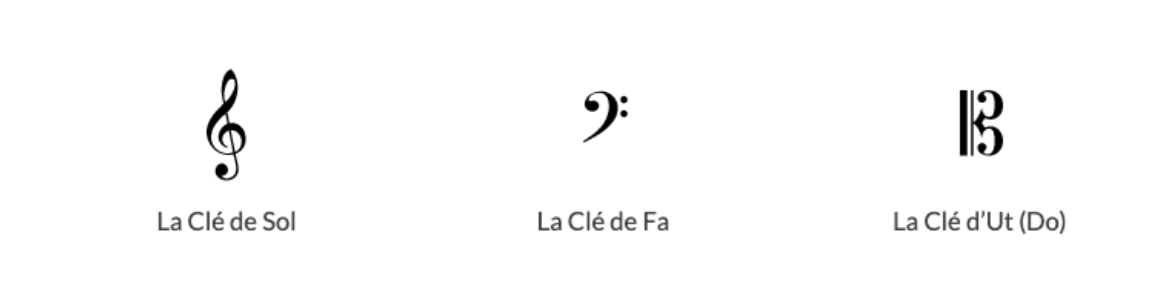
To help you find your way, usemiddle Cas a reference point:
On thetreble clef, middle C is locatedbelow the staff.
In theBass clef, middle C is placed above the staff.
In thetreble clef, theC note is placed directly on the line of the clef.
Once the reference note has been identified, all the other notes can be easily found by moving up or down the staff.
Transposing from listening and reading: the art of reading the "right" notes
One of the nuances to keep in mind when learning to read an orchestral score is that what you see on the page isn’t exactly what you hear. To master this distinction, you need to be able to translate the notation on the staffs into the orchestra’s actual performance.
Identify the instruments in C (flutes, oboes, and strings):
No surprises here: what’s written matches the actual sound and the expected pitch. Note that the double bass actually sounds an octave lower than what’s written, but without any transposition of the interval.
Identify transposing instruments:
An instrument called a " transposer " reads one note but produces another.
Example: When the B-flat clarinet or trumpet is supposed to play a C according to the score, it will actually produce a B-flat (one tone ). The same applies to the F horn, which will play an F instead of the C written in the score (a fifth lower).
What method should be used to identify the actual note? The principle is simple: just identify the tonality (B♭, F, A, etc.) and then calculate the interval between the written note and the tonality :
B-flat trumpet → go down a tone.
F horn → go down a fifth.
🎼 Identify the actual notes in your sheet music more easily!
Upload your sheet music to Newzik and annotate your staves as much as you like to make things easier for yourself. Read through your sheet music, write down the actual notes to play in the margin, and you’re all set.
Understanding the terminology
Reading an orchestral score also requires an understanding of musical vocabulary and technical jargon. Here are the terms (mostly in Italian) you should know:
Tutti→ the entire orchestra plays.
Solo→ a featured instrument.
Ripieno→ the rest of the section accompanies.
Col legno→ strike the string with the wooden part of the bow.
Pizzicato→ a technique involving plucking the string.
Sordino / Dämpfer→ mute.
📕 Beyond the standard terminology, an orchestral score is full of abbreviations that need to be understood.
| Name in French | abbreviation (abr) | Italian | Apr | English | Apr | German | Apr |
|---|---|---|---|---|---|---|---|
| Little flute | Small flower | ottavino or piccolo | Peak. | Piccolo | Peak. | Pikkoloflöte | Pik. |
| Concert flute | Fl. | flauto | Fl. | Flute | Fl. | large flute | Fl. |
| G-flute | Fl. in G | alto flute | Fl con. | Alto flute | Alt fl. | Alto flute | Altfl. |
| Oboe | Htb. | Oboe | Ob. | Oboe | Ob. | Oboe | Ob. |
| English horn | Revenue. | English Horn | B.S.E. | English horn | In H. | English horn | Eng. |
| Small clarinet | Small class | piccolo clarinet | cl. Pic. | E-flat clarinet | Eb major | The Clarinet | Es Kl. |
| Clarinet | Cl. | Clarinet | Cl. | Clarinet | Cl. | Clarinet | Sure. |
| Bass clarinet | Class B | bass clarinet | Class B | Bass Clarinet | B. Cl. | Bass clarinet | Bklar |
| Bassoon | Bon (Bsn) | Bassoon | Fag. | Bassoon | Bn | Bassoon | Fag. |
| Contrabassoon | C. Bon (Bsn) | contrabassoon | cfag. | Contrabassoon | CBN. | Contrabassoon | Kfag. |
A few additional abbreviations in orchestral scores you should know:
div.(divisi) → the part is divided into several parts.
a2→ both instruments play the same line at the same time.
1. solo / 2. solo→ a single musician is playing.
muted →with a mute.
senza sord.→ remove the mute.
While Italian is the most common language used in orchestral scores, you may also come across instructions in German (in the works of Wagner or Mahler) or in English.
Analyze the melody and texture
Studying the melody helps you understand the musicality of a score. Here are a few steps to guide you in analyzing the composition of a piece:
Listen to the piece and try to understand its structure and density: are the parts played simultaneously? Does the entire orchestra play at the same time? Are there any rests, and how many bars ?
Determine the sound hierarchy of the melody: which instruments primarily carry the melody (violins, woodwinds, brass?) and which accompany it (violas? double basses? horns providing harmonic support?)
Understand the piece’s musical structure: is it homophonic (synchronized vertical chords), polyphonic (instrumental parts playing independently), or in unison (all instruments playing together with power)?
🎵Exercise: Reading a Mozart score
Practice a major theme in classical music: the Symphony No. 40 in G minor, K. 550 by Wolfgang Amadeus Mozart.
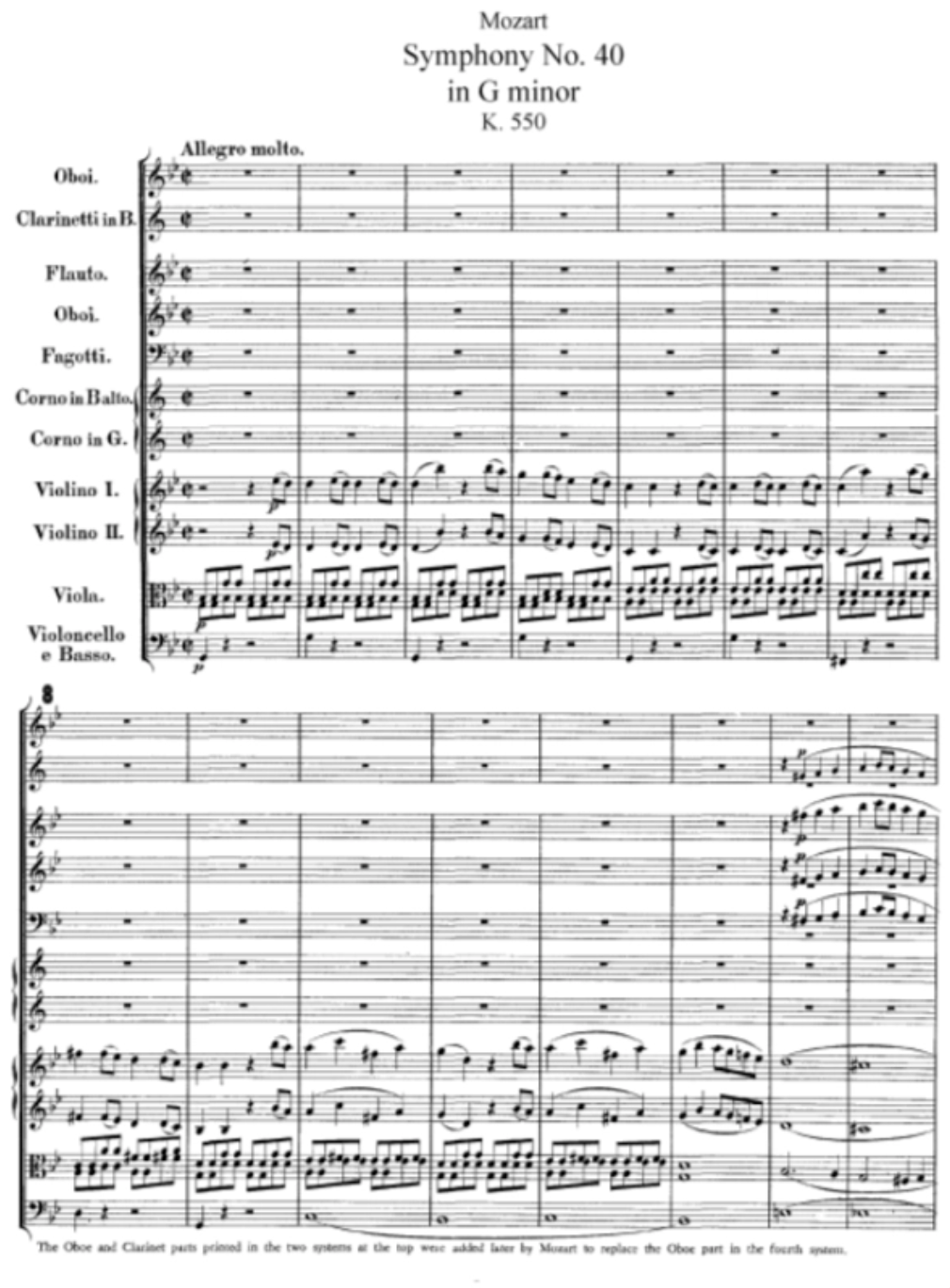
🟓Key points to identify and questions to ask yourself:
→ Orchestra size: As you listen, try to determine the size of the orchestra (identify the instruments and the number of each type: woodwinds, brass, strings, and percussion).
→ Texture: What is the movement of the violas? Which instruments provide harmonic support? What is the theme of the violins?
→ Duplicate parts: Are there any instruments playing the same notes as others? Which ones?
→ The rythm : identify the section that provides the beat (most often, this is the bass strings or percussion).
3 practical tips to make reading an orchestral score easier
Practice " Z " reading (vertical and horizontal)
Instead of reading line by line, learn to scan the page: first vertically to get a sense of the harmony (which instruments are playing together), then horizontally to follow the melodic lines.
Tip: When reading a piece for the first time, identifythree main elements: the bass line, the main melody, and a middle voice (violas or woodwinds). Identifying this trio of instruments makes it easier to understand the overall musical structure.
Practice active listening
By reading the music from the score as it is played, the eye gradually becomes accustomed tothe tempo of the pieceand the way the various instruments are arranged within the composition.
Tip:Focuson a single section at a timewhile listening (for example, the violins). Then expand your attention to the other instruments. Following along with the score while listening to a recording can train your eye to keep up with the tempo of the music.
Make use of digital tools
Apps and tools for scanning sheet music are very useful for learning how to read sheet music. The real-time annotation and quick navigation features offered by the Newzik app are very effective for breaking down the staves and structure of a piece step by step.
Tip:Use color-coded annotations in Newzik to highlight the main themes by instrument. Assigna different color to each element: the melody in red, woodwind entries in blue, and structural changes in green. This visual cue helps you instantly spot the key moments in the piece.
All our tips for working on a piece without using too many resources.
🎼 Are you a member of an orchestra?
Streamline your sheet music management in just a few clicks with Newzik Ensemble ! A collaborative tool for easily digitizing, annotating, sharing, and organizing sheet music. Say goodbye to paper scores riddled with typos and hello to digital scores shared in real time with the other musicians in your orchestra.
Play in perfect harmony with the other musicians in your ensemble, whether in rehearsal, at a concert, or remotely.
