
Leonard Bernstein (1918–1990): biography of a maestro unlike any other
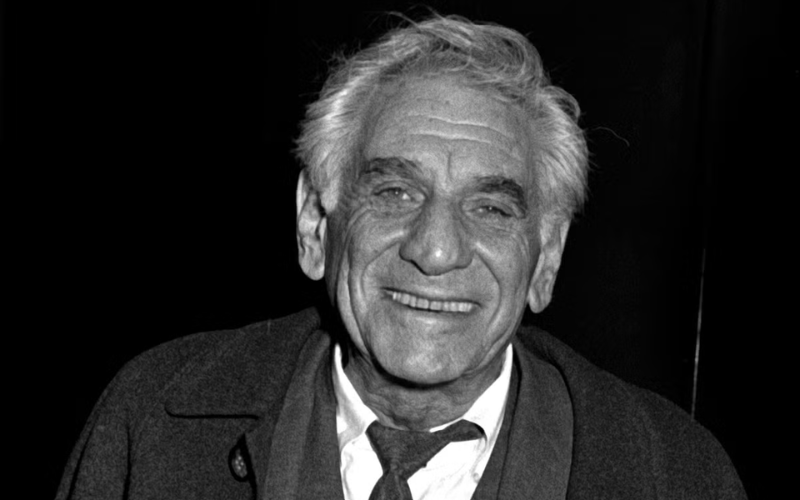
You're probably familiar with West Side Story, but perhaps less so with the man behind it: Leonard Bernstein. Yet behind this famous work lies a musician with an astonishing career.
Studies, encounters, first conducting engagements, career... Discover the portrait of an artist who left his mark on his era, not only through his talent, but also through his way of conveying his passion for music.
A promising start: a child prodigy in music
Leonard Bernstein, born Louis Bernstein, was born on August 25, 1918, in Lawrence, Massachusetts. The future American conductor grew up in a family of Ukrainian immigrants who did not particularly intend for him to pursue a career in music. His passion for music was revealed at the age of 10, when his aunt gave him a piano.
After high school, Leonard Bernstein went on to study at Harvard University, then continued his training at the Curtis Institute of Music. These years of learning were marked by several encounters: Fritz Reiner, a conductor renowned for his high standards, and Serge Koussevitzky, conductor ofthe BostonSymphony Orchestra.
Bernstein was already composing his first works and beginning to take an interest in conducting. His energy and desire to understand music were quickly apparent, a trait that would remain with him throughout his life.
3 anecdotes about Leonard Bernstein
A father who was initially unconvinced
His father did not immediately approve of this musical vocation and initially refused to pay for lessons. Leonard Bernstein then gave piano lessons to other children to pay for his own training, before his father finally agreed to support him.
From Louis to Leonard
At birth, his official first name was Louis, chosen by his grandmother. His parents, however, already called him Leonard on a daily basis. As a teenager, he legally changed his first name to finally be called what everyone else called him.
A star of educational television
Between 1958 and the early 1970s, he hosted 53 Young People's Concerts with the New York Philharmonic Orchestra, broadcast on American television. These introductory music programs left a lasting impression on an entire generation of children and parents.
From substitute to distinguished conductor of the New York Philharmonic Orchestra
In November 1943, Leonard Bernstein was a young assistant conductor with the New York Philharmonic. At the last minute, he was asked to replace Bruno Walter for a concert at Carnegie Hall, and so he took the podium. His performance made a strong impression, and since the concert was broadcast on radio across the country, his name immediately became known far beyond New York.
This date marks a turning point. Leonard Bernstein began receiving offers from American and European orchestras, gradually establishing himself on the international music scene. His highly expressive and sometimes controversial conducting style attracted as much attention as it raised questions, but helped forge his artistic identity.
His relationship with the New York Philharmonic grew stronger over the years. He began by conducting regularly as a guest conductor, then in 1958 became the orchestra's music director, the first American-born conductor to hold this position. He remained in this role until 1969, when he was namedconductor laureate, a title rarely bestowed. Leonard Bernstein returned to the podium throughout his career, becoming one of the figures most closely associated with the New York Philharmonic in the 20th century.
Optimize your rehearsals with Newzik Ensemble
With Newzik Ensemble, your scores are centralized, updated instantly, and accessible to all musicians. This saves valuable time for orchestras, ensembles, and opera companies that want to work faster and more efficiently.
Between classical music and Broadway, Bernstein creates a multifaceted work
Leonard Bernstein began composing at a very early age, with a clear idea in mind that would stay with him throughout his career: not to separate so-called "art" music from popular music.
In 1957, West Side Story brought him worldwide fame. The musical quickly became a global success and left a lasting mark on the history of the genre. But Bernstein's work cannot be summed up by this single title. He also wrote Candide, On the Town, the Chichester Psalms, and Mass, works that are very different from one another, combining influences from classical music, jazz, musical theater, and choral writing.
This blend of styles contributes to his identity as a composer. What characterizes Leonard Bernstein? His ability to bring together musical genres that many considered to be opposites.
Improve your musical theater technique with our tips and exercises to effectively train your voice.
Leonard Bernstein in 5 musical works
West Side Story "Tonight"
“Tonight” is undoubtedly one of the most famous passages from West Side Story. The musical, which premiered on Broadway in 1957, revisits the story of Romeo and Juliet in a New York City marked by tensions between communities. Bernstein blends jazz, classical music, Latin rhythms, and American musical theater. The duet between Maria and Tony has become one of the show’s highlights.
Overture to Candide, orchestra conducted by Leonard Bernstein
A lively and brilliant piece, symbolic of his sense of rythm irony. The overture is now one of his most frequently performed pieces in concert.
On The Town “New York, New York”
In "New York, New York," Bernstein captures the city's energy with lively, rousing orchestral jazz. It is a simple, straightforward piece that showcases his early work on Broadway.
Mahler - Symphony No. 2 in C Minor "Resurrection," orchestra conducted by Leonard Bernstein
Leonard Bernstein is often considered one of the greatest advocates of Mahler in the 20th century. He contributed greatly to bringing Mahler's symphonies back to the forefront of the orchestral repertoire. In this recording of the Second Symphony, we find everything that characterizes his conducting: intense energy at the podium, mastery of nuances, and a genuine understanding of the spiritual nature of the work.
Chichester Psalms, conducted by Leonard Bernstein
The Chichester Psalms are among Bernstein's most personal works. Written in Hebrew in 1965, they combine elements of liturgical tradition with highly modern musical writing. The ensemble forms a luminous and accessible choral piece. It reflects Bernstein's taste for contrasts, vocal colors, and the search for a balance between spirituality and expressiveness.
Leonard Bernstein: a committed artist
Beyond the stage and composition, Leonard Bernstein was always interested in the social and political issues of his time. He supported civil rights movements, worked alongside African American artists and intellectuals, and took a stand against the Vietnam War.
His personal life is equally marked by freedom. Married to Chilean actress Felicia Montealegre, he embraces a complex private life, without seeking to conform to a traditional image imposed by his public status.
Leonard Bernstein leaves behind the portrait of a man who was not limited to music: a charismatic artist, attentive to others, and often ahead of his time in his way of thinking and acting.
Bernstein, music as a universal language
Even at the end of his career, Leonard Bernstein never really left the stage. He continued to conduct in Europe, notably in Vienna, London, and Paris, and in 1989 he took part in the concert in Berlin organized after the fall of the Wall. He died the following year, in 1990.
His compositions, recordings, and numerous documentaries dedicated to him attest to his extensive legacy, which continues to influence musicians and the general public alike.
Leonard Bernstein: key dates to remember
1918: Born in Lawrence, Massachusetts, as Louis Bernstein.
1935–1940: studied at Harvard, then trained in music at the Curtis Institute of Music.
1943: Replaces Bruno Walter at Carnegie Hall and becomes known throughout the country.
1944: first musical with On the Town.
1951: Marriage to Felicia Montealegre.
1957: Creation of West Side Story, an international success.
1958–1969: Music Director of the New York Philharmonic.
1963: Composition of Symphony No. 3, Kaddish.
1971: Creation of Mass, a hybrid and socially conscious work.
1989: Conducted the concert celebrating the fall of the Berlin Wall.
1990: died in New York at the age of 72.
Newzik Ensemble: a platform designed for orchestras and ensembles
Newzik Ensemble is a collaborative tool designed to facilitate the work of musical ensembles. The web platform and iOS app allow you to centralize all your sheet music, share changes in real time, and track the progress of annotations for each section.
Do you work in an orchestra, ensemble, or opera company? Newzik Ensemble offers a fluid and modern workspace, adapted to the constraints of rehearsals and the demands of concerts. It's a simple way to harmonize collective preparation and increase efficiency on a daily basis.
